AI is ubiquitous in our daily lives now—and regardless of whether we love or loathe it, it does seem to be here to stay. While I am not a developer, I’ve come across many requests from clients hoping to understand more about GEO in China, hence I thought this would be an interesting topic to cover.
So what is GEO, and why does it matter in China?
In short: as AI-powered conversation and reasoning models become the front door to how users find answers, the rules of visibility, discovery, and influence are shifting. In China, these shifts are especially dramatic, especially given language, regulation, and the dominance of domestic tech ecosystems.
In this post, I’ll walk through:
- The evolution: from SEO to SMO to GEO
- How AI user growth has exploded in China
- Key AI / GEO platforms in China
- How brands and marketers can prepare and adapt
- Some caveats and challenges
- What this means for the future of marketing in China
1. From SEO → SMO → GEO: China’s Digital Evolution
If you look back 10 to 15 years, SEO was king. I still remember the phrase “content is king” being everywhere. Brands were competing for keywords, backlinks, and top rankings on Baidu or Google. I even remember sitting in a meeting with a major tech company in China almost 15 years ago, discussing how Chinese users often preferred long-tail or question-based searches rather than specific keywords.
Then social media optimisation (SMO) took over: presence and engagement on WeChat, Weibo, Douyin, Xiaohongshu (RedNote), etc., became a core part of discovery and branding.
Now we’re entering what many known as GEO: Generative / AI-Engine Optimisation. In this world:
- Users ask rather than search keywords (which isn’t too dissimilar to the usual behaviour for Chinese audiences)
- Models consume and synthesize content, then produce answers or responses.
- The “source attribution” models use becomes crucial; brands want their content to be referenced, cited, or embedded in AI answers.
- SEO, content marketing, and social media blur into one: you need content that’s not only discoverable, but model-friendly (structured, semantically rich, trustworthy).
In China, this shift is pronounced because domestic AI apps are racing fast, and the Chinese language plus regulatory constraints make global models less relevant. So mastering GEO in China means aligning with the Chinese AI ecosystem and understanding how Chinese models “think.”
2. AI / GEO User Growth in China: The Numbers
To understand how fast things are moving, let’s look at the data (and for full transparency, I used AI to help me search for these data!)
DeepSeek’s meteoric rise
- After launching its R1 reasoning model in January 2025, DeepSeek hit ~ 22.15 million daily active users globally in a short span. (Backlinko)
- In January 2025, DeepSeek had ~ 33.7 million monthly active users (MAUs). (cropink.com)
- China accounts for a large share of those users: e.g. ~30.71% of its MAUs come from China. (Backlinko)
- Within ~20 days of launch, DeepSeek reportedly surpassed 20 million DAUs, reaching ~40% of ChatGPT’s base. (TrendForce)
These numbers show how quickly a GEO / AI app can scale in China—especially if it catches the user imagination and integrates well.
Market and industry growth
- The core AI industry in China had a scale of ¥578.4 billion yuan (≈ US$79.7 billion) in 2023, growing ~13.9% year-on-year. (China Daily)
- Generative AI adoption by Chinese enterprises was ~15% in 2023. (China Daily)
- The Chinese AI market is projected to grow with a CAGR of around 33.9% from 2025 to 2033, reaching USD 327 billion by 2033. (Grand View Research)
- Some reports estimate the Chinese AI market (2023) at ~USD 29 billion, with strong growth toward 2032. (Credence Research Inc.)
These trajectories underpin the notion that AI, and by extension GEO, will be a central battleground for marketing and brand influence.
3. Key Platforms & Players in the China GEO Ecosystem
DeepSeek may be the headline act, but it’s not alone. There are quite a few other key players in the market. To understand how brands must adapt, let’s do a quick tour of what else is in play.
DeepSeek / R1
DeepSeek’s R1 model made headlines because it was resource-efficient, reportedly cheaper to develop, and yet highly capable. (EMARKETER)
Because it’s locally developed, it’s optimised for Chinese language, cultural context, and domestic regulatory compliance. That gives it a built-in edge in China over foreign models. (Yahoo Tech)
However, competition is rising; for instance, Alibaba’s Qwen is positioning itself as a challenger. (South China Morning Post)
Other AI / Q&A Apps and features
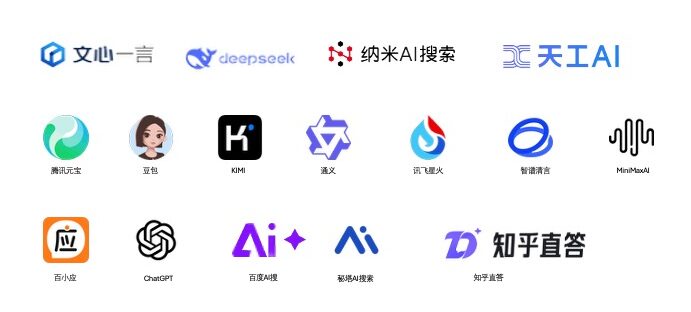
- Nanai AI Search (纳米AI 搜索, “Nano AI Search”): Launched by 360 (Qihoo 360) in late 2024, this app supports multimodal search (text, voice, photo, video) and integrates with local model infrastructure.
- Yunbao / Kimi / Wenxin Yiyan / Doubao: These are among other AI / Q&A / content apps embedded within Chinese ecosystems (e.g. Tencent, Baidu, ByteDance). (You’ll want to dig into their individual features and market share; public reporting is uneven.)
- Tech giants’ models and integrations: Baidu, Tencent, ByteDance, Alibaba are building or integrating large language models (LLMs) into existing apps (search, social, content platforms).
Because these platforms are often part of broader ecosystems (social, search, content), brands need to think holistically—not just as “AI apps” in isolation. Why do I say this? For those familiar with China’s digital landscape, it’s no surprise that each tech giant tends to prioritise its own ecosystem. For example, while Baidu’s Wenxin Yiyan draws primarily from Baidu’s search index, Tencent’s AI tools, such as Yunbao or those embedded in WeChat, tend to surface content from within Tencent’s ecosystem, including WeChat and QQ.
Why this matters: reference attribution & content ingestion
One of the biggest shifts is which sources these models “learn from” or reference when producing answers. If your content is structured, authoritative, and accessible, your brand has a chance to be quoted or included in AI-generated answers. If not, you risk invisibility, even if you invest heavily in SEO or social media.
4. How Brands & Marketers Can Adapt to GEO in China
This is the “so what” part. How do you move from awareness to action? Here are practical steps and examples (real or hypothetical) that brands can take.
4.1 Understand the “AI conversation interface”
- Think of GEO like search + Q&A + assistant: users ask questions, get synthesized answers, and may follow-up.
- Your content needs to be structured for machines: use clear headings, schema/metadata, FAQ-style Q&A blocks, succinct authoritative statements, citations, and good data sourcing.
- Use multimodal content: images, charts, audio, video—if the model supports them.
- Aim to be “referenceable”: create content that can be quoted verbatim, with clear attributions (e.g. “According to X, …”).
Example: Suppose a skincare brand in China publishes an in-depth Q&A page titled “How to choose a sunscreen for humid weather.” If that page is well structured and optimised, when users ask via DeepSeek or other AI apps, the model may choose that page as its response or part of it.
4.2 Balance volume + depth
You’ll want both breadth (many relevant questions/topics) and depth (few cornerstone “evergreen” reference pages).
- For niche segments or subtopics, create micro-Q&A pages.
- For high-value verticals, produce deep guides with authoritative data, industry insights, visuals, etc.
4.3 Monitor model behaviour & “snippets”
- Use tools (if available) or partner with Chinese SEO/ GEO firms to see which content gets surfaced by AI apps.
- Reverse-engineer which phrases/questions/models are being used.
- Adjust and reformat content to match those patterns.
4.4 Leverage partnerships & platforms
- Collaborate with AI platforms: publish content directly or via official channels inside those apps (if platforms allow).
- Use branded mini-programs or apps / plug-ins inside AI / chat ecosystems (if the platform supports it).
- Use data APIs or feeds so the platform has better access to your content.
Example: A financial services brand in China may partner with a Q&A AI app so that when users ask, “How to invest small amounts of money in second-tier cities,” the AI model can fetch real-time data from the brand’s feed (e.g., interest rates, fund performance) and inject it into answers.
4.5 Translate & localise intelligently
For foreign brands, simply translating global content may not work well. You need to localize not just language, but tone, data, references, style, and cultural context.
Also, models might favour domestic Chinese content sources, so building local authority matters.
4.6 Stay current and keep up with rapid updates
Because AI models evolve, you want to publish fast, small updates. Data charts, findings, user insights … that can keep you “fresh” in the models’ knowledge graphs.
5. Caveats, Risks & Challenges
This is not a silver bullet. Here are some critical caveats:
- Model bias, hallucination, and safety: Some studies show that DeepSeek (and models in China) can be vulnerable to prompt attacks or produce unsafe outputs.
- Competition & fragmentation: New models (e.g. Alibaba’s Qwen) may fragment the landscape, so you can’t bet everything on one app. (South China Morning Post)
- Regulation & censorship: Chinese content regulation, censorship, data residency, and oversight will influence what these models can show or reference.
- Attribution & “black box” nature: Even if your content is quoted, you may not fully know how or why the model chose it, making ROI harder to track.
- Platform dependency: If you’re too deeply embedded in one model’s ecosystem, you risk exposure if their rules change.
Because of these risks, GEO strategy should be diversified, continuously monitored, and integrated with SEO, social, content marketing, and PR—not be a stand-alone tactic.
6. The Future: GEO, Marketing, and China
As GEO takes root, here’s what one can expect:
- Search, social, and AI will further converge. The boundaries will blur: your Douyin post, Baidu article, and AI Q&A page all become parts of one content continuum.
- Brands with trust + depth + structure win. You want your content and data to be viewed as authoritative by models.
- Agile content, not static content, will dominate. Fast updates, micro-insights, and living content will attract model attention.
- Offline & hybrid experiences will matter more. GEO will push users deeper into conversion, but brands that connect AI-driven awareness with real-world activation (stores, events, O2O) will gain advantage.
- Marketing roles will evolve. PR, influencer, content, SEO teams will need overlap with data science, AI operations, and “model optimisation” roles.
With the digital landscape in China evolving faster than ever, marketers who understand the power of GEO will be the ones shaping the next era of influence. I’m excited to see how these innovations will redefine not only how brands communicate, but how we, as marketers, create meaningful connections in an AI-driven world.
Looking to grow your brand in China? Let’s talk. With the right strategy and local insight, you can skip the guesswork and make your China launch a success.